The itch
It is hard to picture an economy that isn't this one. We are not great at imagining past the thing we live in.
Projects / 04
All projectsA museum from 2060. Capitalism is over. Come and see what it left behind.
How much time do you have?
At a glance
Hyper Compass
It is hard to picture an economy that isn't this one. We are not great at imagining past the thing we live in.
Museum of Post-Capitalism: an experiential museum set in 2060, in a future where capitalism has been overcome. Today's systems are shown as relics, so visitors question how inevitable they looked.
It is an open platform. Designers, artists, writers and anyone else add real or speculative work. Nobody tells you what the future should be.
In use
Banknotes from 2022 to 2060 that ask who deserves to sit at the centre of society.
Price tags that expose what a product really costs.
Earth Language Model: a system for ecological translation and political mediation, presented through a living plant.
The prototype
A museum visit from the other side: the old economy as an exhibit.
/imagine a world beyond capitalism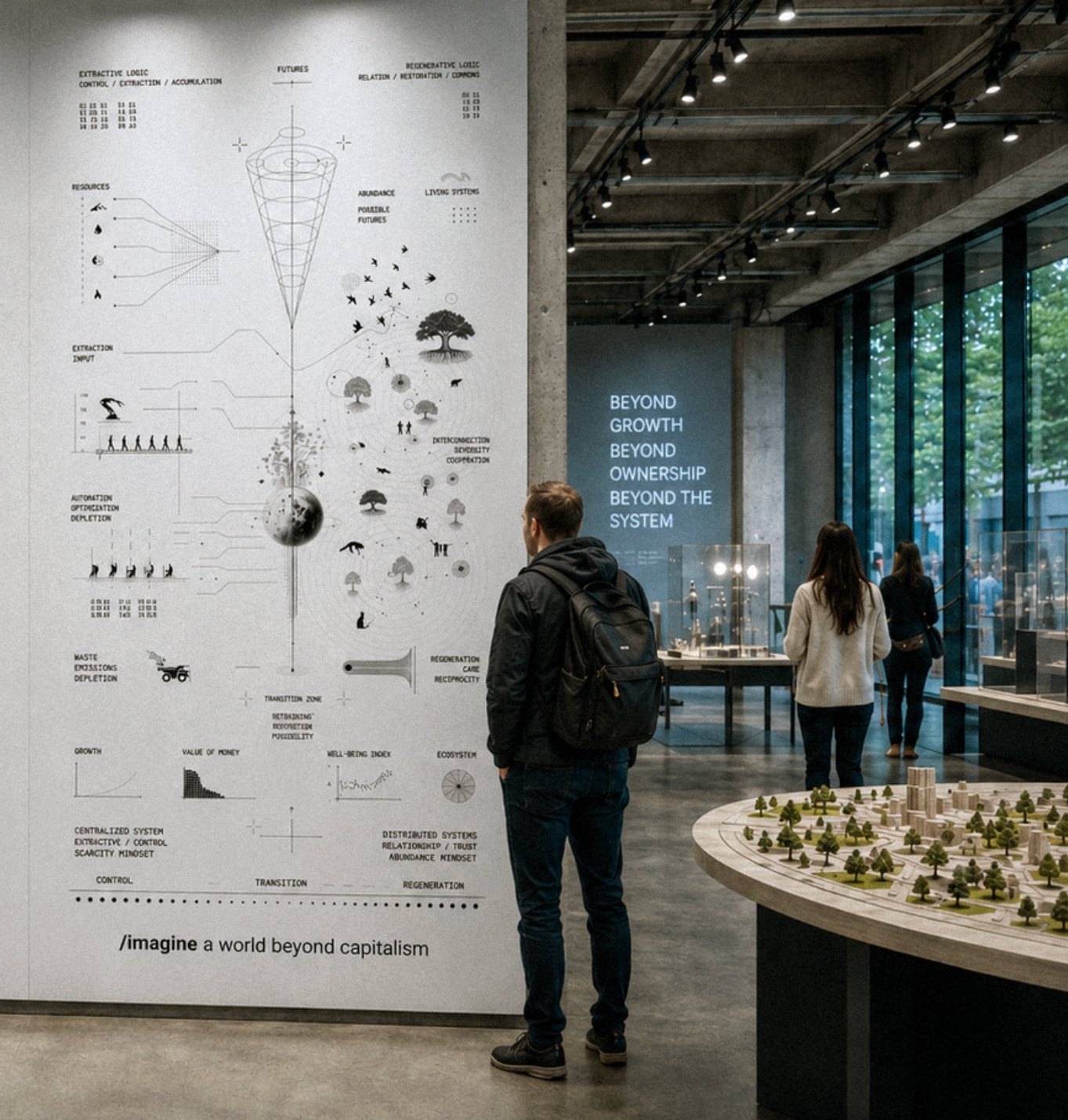
Behind the scenes
MOP belongs to the Post-capitalism project. Its research arm, Post-capitalism [LAB], sits within a Royal College of Art research project and mixes theory, interviews with professionals and participatory design across London, Madrid and Mexico.
The first edition was shown in London in 2026, with support from IED and that research lab.
One museum, a new edition in every city. Each one is a test of the idea.
Designers, artists, writers and people from any discipline contribute work, real or speculative, that helps us think beyond capitalism.
Around the pieces: talks, debates and workshops, so the future turns into a discussion about the present.
Mass tourism, land speculation, pressure on water and a growing digital-nomad economy. And practices that already run on other logics: subak (cooperative water management), banjar (community associations) and gotong royong (mutual cooperation).
MOP's premise is that alternatives exist at the margins and need to be made visible, credible and desirable. Bali has the problem and some of the answers.
One node of a distributed museum, not a copy of London. Hosted by a local partner.
Modular pieces from London, Lima and Quito, plus new work from Indonesian designers chosen through an open call on Bali themes.
Hidden Cost price tags for a villa night, a scooter rental or a litre of water. Kingdoms of Value as rupiah notes from 2060. ELMO with a locally grown plant.
An opening talk, a critical and speculative design workshop and a public debate with local voices. In English and Bahasa Indonesia.
A gallery, creative hub or campus with room for a small exhibition and a talks area.
A Balinese or Indonesian designer, curator or academic to shape the open call and the programme with us.
Universities and design schools for workshops, and local groups working on land, water and community.
The principle
The best way to criticise the present is to visit the future.
What we learned
HunchAn object from 2060 starts conversations a slide deck doesn't.
HunchWhat feels obvious in London may land differently in Lima, Quito or Bali. Each edition is a test, not a repeat.
HunchWe're not selling a post-capitalist model. We're making room to argue about one.
Honest bits
How it lands elsewhere. A museum from 2060 will mean different things in Lima, Quito and in Bali. We'll learn that by going.
What changes afterwards. Good conversations are easy to start and hard to measure. We'll add what we can stand behind, and nothing else.
A living project. This page grows as the editions happen.
Next