The itch
A scary message lands in the family group. Three taps later it is in four more. Nobody checked. Nobody ever does.
Projects / 03
All projectsA seatbelt for sharing.
How much time do you have?
At a glance
Hyper Compass
A scary message lands in the family group. Three taps later it is in four more. Nobody checked. Nobody ever does.
A plugin that scores outlets and stories, stamps a "made by humans" seal where it is earned, and adds a little friction at the exact moment you hit share.
It never tells you what to think. It shows how other outlets told the same story and asks one good question: who wins if this spreads?
In use
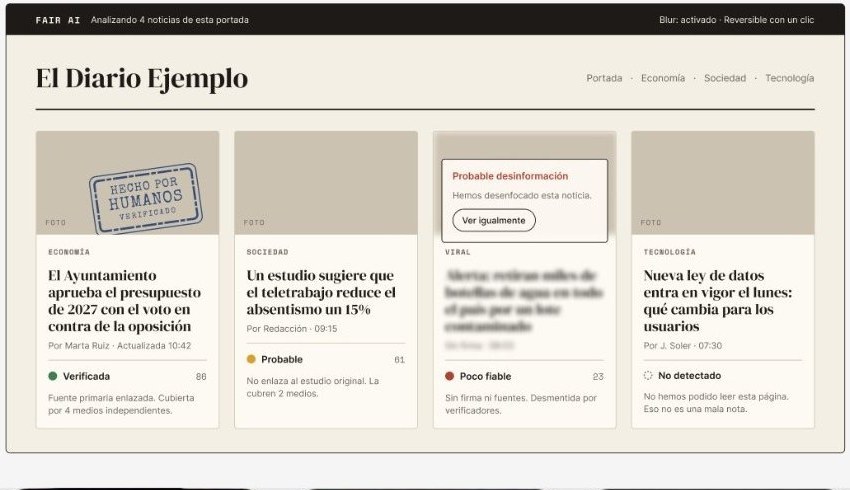
Two layers: the outlet and the story. Front pages in four states, and share flows for the places people actually share.
Try the demo front page Try the demo chat Names and data are fictional. Interface in Spanish: Spain is the first market.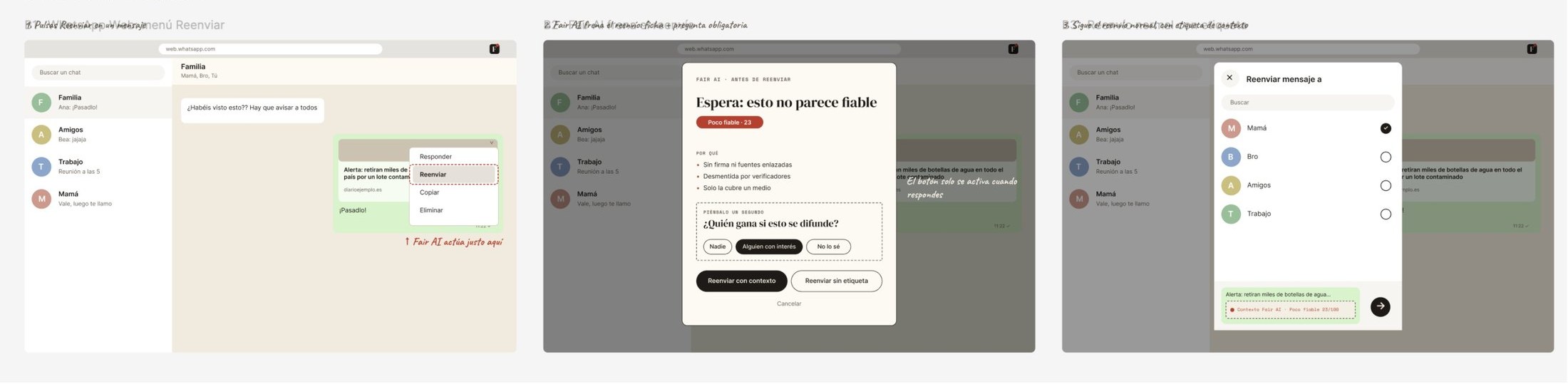
Research
Showing how the same story is covered across outlets is a good idea. Our plan is to take it to Spain and put a brake on sharing.
Behind the scenes
We started with a spinning wheel of questions before sharing. Fun, and wrong: you can win a game in a hurry. We swapped it for "Compare before sharing".
The friction is invasive on purpose. It triggers when you press share, not when you decide to be careful. The people who decide to be careful already are.
Two more tools: a "made by humans" stamp on the front page when no AI is detected, and a blur that grows with doubt and clears with a click.
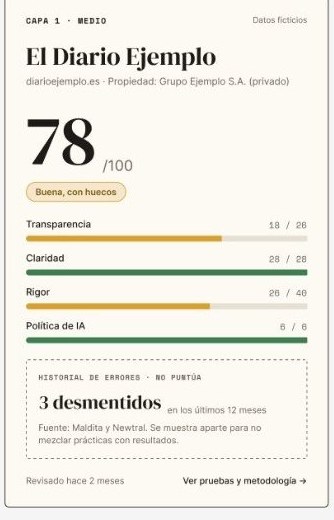
A card with 12 criteria and 100 points: transparency, clarity, rigour, AI policy. Past errors are shown apart, never mixed into the score.
Nine criteria per article, weighted towards cross-coverage and fact-checker contradictions. No political-lean labels.
Press share and the share is stopped: signals from the story, how other outlets tell it, fact-checker searches and one question. "Share with context" adds a line to your message.
The principle
Don't tell people what to believe. Give them a reason to pause.
What we learned
A brake you choose to press is a brake for people who were already careful. This one is on by default.
"Here is how others told it" works better than "this is false". It trusts you with the answer.
On real outlets the extension shows "pending evaluation" and the signals it can read: byline, dates, outside links. "Not enough data" is never a zero.
Honest bits
Scores are power. Judging real newspapers needs a published method, human review and a right of reply. Until then, nothing real gets a number.
The seal has to be earned. Telling what's made by humans is hard, so the seal needs evidence, not a hunch.
Each site builds share buttons its own way. The extension is not tested on the real news sites yet, and it doesn't touch the real WhatsApp Web: the demo chat is a simulation.
Nobody has tried it. Next step: test the share moment with real people, on real chats.
An experiment, not a product. The point is what we learn.
Sources
Next